

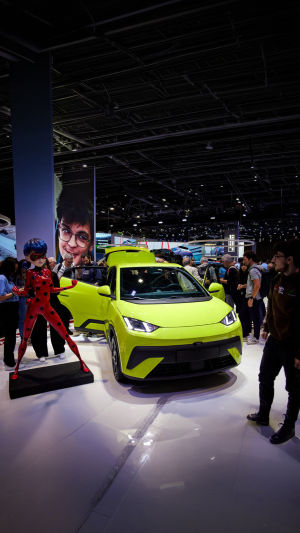
Europe's luxury car market is facing growing competition from Chinese manufacturers offering high-tech electric vehicles. Rather than relying on established reputations, these newcomers are highlighting intelligent driving systems, rapid charging and advanced comfort features.
At the 2026 Paris Motor Show, several Chinese brands introduced premium models designed to compete with established European manufacturers. Their expansion reflects growing demand for sophisticated electric vehicles and increasing pressure in China's domestic automotive market.
<h3>Why Chinese Carmakers Are Targeting Europe</h3>
Chinese manufacturers have already expanded their presence in Europe's mainstream vehicle market through competitively priced electric cars. Now, companies including BYD, Changan and Geely are seeking opportunities in the more profitable premium segment.
The strategy follows a difficult period in China, where domestic vehicle sales declined by 20% during the first half of 2026.
Europe offers substantial opportunities. BMW, Mercedes-Benz, Audi and Porsche collectively sold almost two million vehicles across the continent during the first nine months of 2026.
According to estimates from Avatr, Europe accounts for approximately 72% of premium vehicle sales above €44,500 outside the United States.
However, established European manufacturers benefit from decades of customer loyalty, making market entry challenging for unfamiliar competitors.
<h3>Technology Becomes The New Luxury</h3>
Chinese brands are promoting a different interpretation of premium motoring, placing digital innovation at the centre of their vehicles.
At the Paris exhibition, Avatr presented an electric saloon and SUV with prices starting at approximately €60,000.
Both models feature rapid-charging capabilities and advanced comfort equipment, including massage functions for every seat.
Aito, another Chinese premium brand, introduced four electric SUVs while highlighting sophisticated driver-assistance technology and automated obstacle avoidance.
These features illustrate how manufacturers are increasingly using software, intelligent systems and passenger comfort to distinguish their vehicles.
Traditional European luxury brands continue to emphasise craftsmanship, materials and heritage, although they are also investing heavily in electrification and digital technology.
<h3>Chinese Premium Brands Expand Their Reach</h3>
Several manufacturers are already recording substantial growth in Europe.
Zeekr, part of Geely, sold 9,525 vehicles across European markets during the first nine months of 2026, compared with 3,025 during the corresponding period in 2025.
The company has entered 22 European markets and intends to expand into eight additional countries during 2026.
Xpeng has also increased its presence. Its European sales more than doubled to over 29,000 vehicles during the first eight months of the year.
Meanwhile, Avatr plans to enter Spain, the United Kingdom and Denmark in 2027, followed by Germany and several additional markets in 2028.
These expansion plans demonstrate growing confidence, although Chinese premium brands still represent a relatively small share of European luxury vehicle sales.
<h3>Can Newcomers Challenge Established Brands?</h3>
Breaking into the premium market involves more than introducing advanced technology.
European customers often associate luxury vehicles with reliability, established service networks, resale values and long-standing reputations.
Chinese manufacturers must develop customer confidence while demonstrating that their vehicles can deliver consistent quality over time.
Industry representatives acknowledge that matching the prestige of established European brands may require another decade or longer.
For consumers, growing competition could eventually mean greater choice, improved technology and more competitive pricing.
As Chinese manufacturers expand across Europe, the definition of automotive luxury may increasingly depend on how effectively traditional craftsmanship and intelligent technology work together.


