

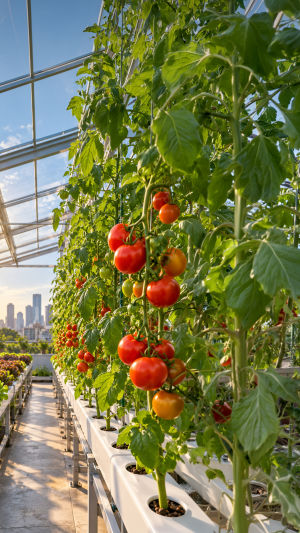
Imagine a city where rooftops produce fresh vegetables, wastewater becomes a valuable agricultural resource and unused building space helps feed local communities. Urban farming offers exciting possibilities, but making these systems environmentally sustainable remains a challenge.
Researchers at the Autonomous University of Barcelona have spent eight years investigating how rooftop greenhouses can produce food more efficiently.
Their findings reveal that relatively simple decisions, from maintaining greenhouse roofs to choosing the right fertilisers, can dramatically influence crop yields and environmental performance.
The study, published in Agronomy for Sustainable Development in October 2026, provides valuable insights into the future of food production in increasingly crowded cities.
<h3>Eight Years Of Growing Tomatoes</h3>
The research focused on an experimental rooftop greenhouse at the university's campus in Barcelona. Integrated into the building and thermally connected to it, the facility offered an opportunity to study agricultural production in an urban environment.
Between 2015 and 2023, scientists examined 11 tomato-growing cycles, comparing productivity, resource consumption and environmental impacts.
Their objective was to identify practical improvements that could make urban agriculture more productive while reducing its ecological footprint.
The results highlighted two particularly important factors: the amount of sunlight reaching plants and the efficient management of nutrients throughout their development.
<h3>Sunlight Makes A Remarkable Difference</h3>
Natural light emerged as the most influential factor affecting tomato productivity.
Over time, the plastic panels covering the greenhouse gradually deteriorated, reducing the amount of sunlight reaching the crops. Researchers linked this deterioration to a 31% decline in production across the eight-year study.
When the ageing panels were replaced in 2023, tomato yields increased by more than 56% compared with the previous year.
The findings suggest that regular maintenance can be just as important as sophisticated agricultural technology.
Although manufacturers often recommend replacing greenhouse coverings after approximately ten years, the researchers propose a shorter interval of four to six years.
Their calculations indicate that this approach could also reduce the greenhouse's overall carbon footprint by approximately 6.7–7.7%.
<h3>Turning Wastewater Into Fertiliser</h3>
Another promising discovery involved struvite, a phosphorus-rich mineral that can be recovered from municipal wastewater treatment facilities.
Phosphorus is essential for plant growth, but conventional fertiliser production and nutrient losses can create environmental problems.
The researchers tested whether recovered struvite could provide an effective alternative for tomato cultivation.
They found that applying an optimised quantity of 100 grams per plant produced the highest harvests recorded during the study, with performance comparable to conventional mineral fertilisation.
The approach also offered an important environmental advantage by reducing pollution associated with nutrient runoff into waterways.
Recovering valuable nutrients from wastewater could therefore help cities develop more circular food systems, where resources are reused instead of discarded.
<h3>Are Indoor Farms Really Greener?</h3>
The scientists also compared rooftop cultivation with an indoor tomato-growing system using artificial LED lighting.
Although indoor farming demonstrated efficient water use, its environmental impact was considerably higher because of electricity consumption.
The indoor system generated approximately 7.06 kilograms of carbon dioxide equivalent per kilogram of tomatoes. By comparison, the most efficient rooftop greenhouse cycles produced approximately 0.54–0.94 kilograms.
Electricity accounted for more than 93% of the indoor system's environmental footprint.
However, the researchers identified a potential solution. If all electricity came from solar photovoltaic energy, the indoor system's estimated carbon footprint would fall by 87%, reaching approximately 0.93 kilograms of carbon dioxide equivalent per kilogram of tomatoes.
This demonstrates how strongly the sustainability of indoor agriculture depends on its energy supply.
<h3>What This Means For Future Cities</h3>
The findings offer practical guidance for urban farmers, architects and policymakers interested in developing more sustainable food systems.
Maintaining transparent greenhouse coverings, adjusting fertiliser application and using recovered nutrients can all improve agricultural performance. Renewable electricity could also make artificially illuminated growing systems significantly more environmentally competitive.
Importantly, the study shows that progress often comes through continuous monitoring and gradual improvements rather than a single technological breakthrough.
As cities search for ways to produce fresh food closer to consumers, these lessons could help transform rooftops and other urban spaces into productive agricultural environments.
The future of urban farming may depend on something surprisingly straightforward: understanding how plants use light, nutrients and energy, then managing those resources as carefully as possible.