

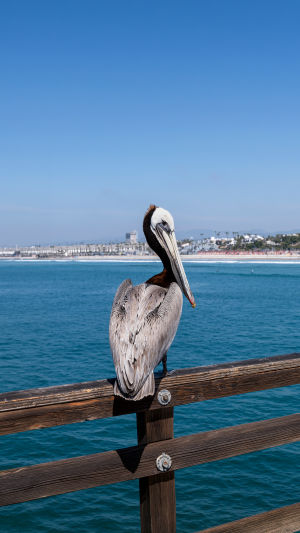
Brown Pelicans may look perfectly at home beside warm beaches, but their survival depends on something much colder beneath the surface. Along the Pacific coast, these birds feed heavily on northern anchovies. Anchovies, in turn, rely on cold, nutrient-rich water rising from deeper layers of the ocean.
This process, known as upwelling, feeds plankton and supports an entire marine food web. When surface waters become unusually warm, that system can begin to weaken. <b>The birds may not be harmed by warm water directly. The danger often begins several steps below them in the food chain.</b>
<h3>Heat Changes the Menu</h3>
Marine heatwaves occur when ocean temperatures remain significantly above normal for a particular region and season for days, weeks or even months.
Warm surface water can suppress the upward movement of colder, nutrient-rich water. With fewer nutrients available, plankton production may fall. That can reduce food for small marine organisms and forage fish such as anchovies, herring and Pacific sand lance.
Pelicans are not the only birds affected. Murres, auklets, cormorants and shearwaters also depend on fish, krill and copepods supported by cold-water ecosystems. When prey becomes scarce or moves elsewhere, seabirds may have to travel farther and use more energy just to find enough food.
<h3>A Major Heatwave Is Underway</h3>
The North Pacific is currently experiencing an exceptional marine heatwave. At Scripps Pier in San Diego, daily ocean temperatures have remained roughly 1.7–3.9°C above average for months, breaking 38 daily temperature records.
It is the longest continuously warm period measured there in more than a century. During the same period, emaciated Brown Pelicans, loons, grebes and cormorants have been found along parts of the coast, while wildlife rehabilitation centres have received hundreds of starving birds. Farther south, surveys in Ecuador recorded more than 1,500 dead seabirds during June and July 2026 — far above expected numbers.
<b>The timing and ecological mechanism strongly connect these events with unusually warm ocean conditions, although individual bird deaths can have multiple contributing factors.</b>
<h3>History Shows the Risk</h3>
Scientists have seen a similar pattern before. Between 2014 and 2016, a vast marine heatwave known as “the Blob” extended from California toward Alaska. Researchers estimate that roughly four million Common Murres were lost during the event, alongside large numbers of other seabirds.
The scale of that die-off was recognised because volunteers and researchers had already been surveying the same beaches for years. By comparing unusually high numbers of dead birds with established baseline conditions, scientists could see that something exceptional was happening.
<h3>Washington Is Holding For Now</h3>
Conditions are currently different farther north. Strong seasonal upwelling has kept coastal waters around Washington relatively close to normal temperatures. Researchers are even seeing increased numbers of Brown Pelicans along the Washington and Oregon coasts this summer, potentially as birds shift toward areas where feeding conditions remain better.
Whether those conditions continue through autumn is uncertain. Long-term monitoring will be crucial because a single warm week matters far less than understanding how temperature, prey availability and bird populations change over months and years.
<h3>Why Monitoring Matters</h3>
Marine heatwaves have become more frequent and severe in recent decades, making repeated food shortages a growing concern for seabirds. Conservation scientists have warned that the problem becomes especially serious when die-offs happen faster than populations can recover between events.
That does not mean every warm period will produce a mass mortality event. Food-web responses depend on location, duration, ocean currents, prey species and many other factors.
<b>But seabirds can act as visible warning signals of changes occurring throughout the ocean ecosystem.</b>
When pelicans and murres begin arriving on beaches underweight and hungry, the problem may have started long before — with warmer water, fewer nutrients and a food chain quietly running short of energy.
The lesson is bigger than any single species. Healthy seabird populations depend on healthy oceans, and sometimes the first sign that something has changed is not found underwater, but washed onto the shore.


