

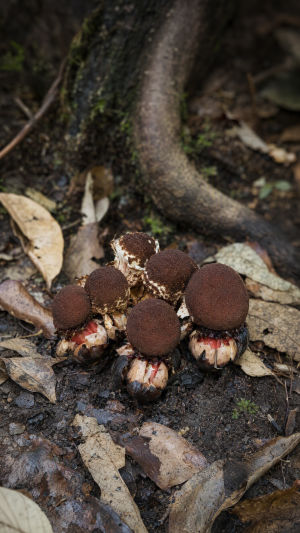
On a tropical Japanese island near Okinawa, an unusual plant grows quietly on the shaded forest floor. Balanophora fungosa is easy to mistake for a fungus because it has no green leaves and survives by drawing nutrients from the roots of other plants.
Its reproductive strategy is just as unusual. The plant can produce up to one million tiny seeds, each enclosed in a minute, dry fruit. For years, one basic question remained unanswered: how do those seeds move away from the parent plant?
The answer turned out to involve an animal few researchers had considered — the land hermit crab.
<h3>A Mystery on the Forest Floor</h3>
At first, seed dispersal by gravity or wind seemed possible. But the environment made those explanations less convincing. The plant grows close to the ground in humid, shaded forests where air movement is limited. Tiny seeds simply dropping nearby would not necessarily help the species spread very far.
Previous research on related parasitic plants had already suggested another possibility. Members of the Balanophoraceae family often produce dull-coloured fruits with unusual smells rather than bright, fleshy fruits designed to attract birds or mammals.
In some species, ants, crickets and cockroaches have been observed carrying away fruits and seeds. That made small invertebrates natural suspects.
<h3>Ants Were the First Suspects</h3>
Balanophora fungosa seemed to fit the same pattern. Its fruits are easy to detach, have muted colours and produce a yeаsty smell. These traits suggested that ants might be responsible for moving them. To test the idea, researchers covered fruiting plants with nets designed to allow ants through while keeping larger animals away.
If ants were the main dispersers, the fruits should still have disappeared. Instead, almost nothing happened. Once larger animals were excluded, the fruits were no longer being removed in the same way. That result pointed toward a bigger visitor.
<h3>Cameras Reveal the Real Visitor</h3>
Time-lapse cameras provided the answer. The main visitor was the land hermit crab Coenobita brevimanus. The crаbs approached mature plants and used their pincers to scrape away the fruits. Their feeding could be surprisingly efficient: in some cases, a crab removed nearly the entire fruiting structure during a single night.
This behaviour immediately suggested that the animals could play an important role in moving seeds around the forest. But the researchers then discovered that the relationship was even more complex.
<h3>Seeds Travel Two Ways</h3>
Some of the tiny fruits became attached to the bodies of feeding crаbs. Hermit crаbs carrying this plant material were later observed several metres away from the original plant, meaning seeds could be transported externally before eventually falling off. The crаbs also ate some of the fruits. Tests showed that at least some seeds survived passage through their digestive systems, creating a second possible route for dispersal.
This matters because land hermit crаbs are capable of travelling substantial distances. Individuals can move as far as around 100 metres, potentially carrying seeds much farther than gravity alone could manage. The study therefore provides evidence that hermit crаbs can act as both external and internal seed dispersers.
<h3>Scent May Be the Invitation</h3>
Another detail makes the relationship especially interesting. The crаbs appeared to visit mature plants rather than immature ones. That suggests they may be responding to the smell produced when the fruits are ready. For a plant growing in a dark forest understory, scent may be a more useful signal than colour.
Instead of attracting birds with bright berries, Balanophora fungosa may be advertising itself chemically to animals already moving across the forest floor in search of food. The yeаsty smell could therefore function as a direct invitation.
<h3>Small Animals, Big Ecological Role</h3>
Seed dispersal research often focuses on birds and mammals because they can carry seeds over long distances. But small invertebrates may be far more important than they appear. On islands, fragmented landscapes and shaded forest floors, animals such as crаbs, ants and insects may provide essential movement for plants whose seeds would otherwise remain close to where they formed.
Land hermit crаbs are usually described as omnivores, scavengers or even seed predators. This discovery shows that they can also become useful partners for plants. Their abundance in coastal forests and broad diet suggest that this behaviour may not be unique to one species or one location.
<b>The discovery changes the way we think about seed dispersal on the forest floor. A hermit crab searching for food may unknowingly become a gardener, carrying the next generation of a parasitic plant through the forest one tiny seed at a time.</b>


