

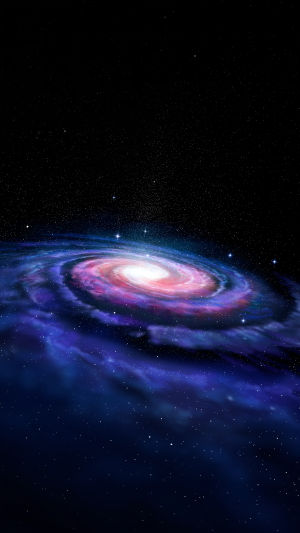
Lykkers! On a clear night, a sky filled with stars can seem endless. Yet the breathtaking galaxies, glowing nebulae, and countless points of light visible through even the most powerful telescopes reveal only a small fraction of the universe.
According to current scientific understanding, everything we can directly observe accounts for less than five percent of the universe's total mass-energy.
The remaining 95 percent is made up of two invisible components—dark matter and dark energy—that continue to challenge our understanding of the cosmos.
<h3>What Can We Actually See?</h3>
The visible universe consists of ordinary matter, including stars, planets, galaxies, gas, dust, and every living organism on Earth. This familiar matter is composed of atoms, the fundamental building blocks of everything we encounter in everyday life.
Despite its abundance in our daily experience, ordinary matter represents only about 4.9% of the universe's total mass-energy. In other words, nearly everything that shapes the universe exists beyond the reach of direct observation.
<h3>The Invisible Influence of Dark Matter</h3>
Dark matter makes up approximately 26.8% of the universe. It neither emits, absorbs, nor reflects light, making it invisible to telescopes. Although it cannot be observed directly, its presence is revealed through gravity.
Astronomers discovered that galaxies rotate much faster than visible matter alone can explain. The additional gravitational influence attributed to dark matter accounts for these observations and helps explain how galaxies and galaxy clusters remain stable over billions of years.
Despite decades of research, the true nature of dark matter remains unknown. Current evidence indicates that it interacts with ordinary matter primarily through gravity, making it one of the most significant unsolved problems in modern physics.
<h3>The Expanding Universe and Dark Energy</h3>
Even more mysterious is dark energy, which accounts for approximately 68.3% of the universe. Observations have shown that the universe is not only expanding but doing so at an accelerating rate. Scientists attribute this phenomenon to dark energy, although its exact nature remains uncertain. Rather than slowing after the Big-Bang, the universe's expansion has continued to accelerate for billions of years, fundamentally influencing the evolution and large-scale structure of the cosmos.
<h3>How Do Scientists Know?</h3>
Because dark matter and dark energy cannot be observed directly, scientists study their effects on the universe. Evidence comes from multiple independent observations, including the cosmic microwave background—the faint radiation left over from the Big-Bang—the motions of galaxies, the distribution of galaxy clusters, and gravitational lensing, a phenomenon in which massive objects bend the path of light. Together, these observations consistently indicate that the visible universe represents only a small portion of the cosmos, while most of its contents remain invisible.
<h3>Why Does It Matter?</h3>
Understanding dark matter and dark energy is essential to answering some of the most fundamental questions in astronomy. These mysterious components influence how galaxies form, how the universe evolves, and how its future may unfold.
To investigate these mysteries, scientists use sophisticated underground detectors, powerful observatories, and advanced space telescopes. Each new observation provides valuable clues, bringing researchers closer to understanding the true composition of the universe.
Every time we look into the night sky, we observe only a small part of the universe. Beyond the stars and galaxies visible to our eyes lies a vast, unseen cosmos dominated by dark matter and dark energy. Although many questions remain unanswered, ongoing advances in astronomy and physics continue to deepen our understanding of the universe, bringing humanity closer to revealing the nature of its hidden majority.


