

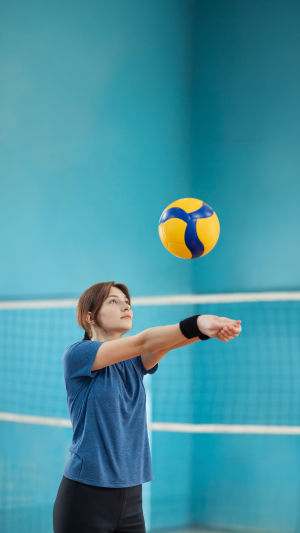
Hello Lykkers, have you ever watched a volleyball match and wondered how players can control the ball so smoothly with their arms?
A strong bump is one of the most important basic skills in volleyball. It looks simple, but it requires good posture, accurate timing, proper force, and teamwork between our whole bodies.
Today, we will explore the key movements of volleyball bumping and learn practical ways to improve our skills. Whether we are beginners or players who want to become more stable, these details can help us understand the technique better and enjoy the game more.
<h3>Building the Right Preparation Position</h3>
Before we bump the ball, we need to prepare our bodies correctly. A good starting position gives us better control and faster movement.
We usually use a half-squat position. Our feet can be placed one in front of the other or slightly apart on both sides. Our knees should bend naturally, our upper body should lean slightly forward, and our weight should move toward the front part of our feet.
At the same time, we keep our arms relaxed in front of our body. This position helps us react quickly when the ball comes toward us. If our body is too straight or our weight stays too far back, it becomes harder to adjust and control the direction.
<h3>Creating the Correct Hand Shape</h3>
The hand position is an important part of a successful bump. A common method is the stacked-hand style.
We place one hand over the other, keep both thumbs aligned and close together, and press the bases of our hands together. Then we extend both arms forward and keep them close.
One detail we should remember is that our palms should not overlap. The goal is to create a stable surface with our forearms so the ball can move in the direction we want. A stable arm platform allows us to receive the ball more smoothly and reduces unexpected changes in direction.
<h3>Finding the Best Contact Area</h3>
When we bump the volleyball, the contact point should be on the lower part of our forearms, about 10 centimeters above the wrist area. Using the correct area creates a wider and more stable surface. If the ball hits directly near the wrist, the contact area becomes smaller, making the ball harder to control.
Another common mistake is using only one arm. When this happens, the ball often loses balance and does not travel where we expect. To improve, we can focus on keeping both arms together and watching the ball carefully before contact.
<h3>Using Straight Arms for Better Control</h3>
During the bump, we should keep our arms straight and close together. Our arms move forward under the ball, and we use shoulder lifting, elbow extension, wrist control, and arm movement together to guide the ball.
Some players rely too much on bending their elbows and lifting their forearms. This reduces stability because the arms cannot create a strong platform. A simple practice method is to repeat the movement without a ball. We can focus on straight arms, shoulder movement, and the feeling of lifting upward. With regular practice, the movement becomes more natural.
<h3>Controlling Direction and Timing</h3>
Good volleyball players do not only hit the ball upward; they control where it goes. When we bump, our goal is usually to send the ball upward above our position. The force should follow a rhythm: first stay calm while waiting for the ball to drop, then quickly apply force at the right moment.
The best contact timing is when the ball reaches slightly above shoulder level. At this point, we can use our legs, shoulders, and arms together to create a smooth upward movement. If our timing is too early, the ball may travel too low. If we react too late, the ball may fly away from our control.
<h3>Using the Whole Body Together</h3>
Volleyball bumping is not only an arm movement. Our entire body works as one system.
The lower body provides support, while the upper body helps guide the ball. When our legs and arms move together, the action becomes smoother and more powerful.
A common mistake is using only arm strength. This often makes the movement unstable because the body cannot provide enough support. We can practice bending and extending our knees while performing the bump motion. This helps us learn how to connect different parts of our body.
<h3>Improving Incorrect Contact Habits</h3>
Some players struggle because they do not clearly know where the ball should touch their arms. A useful training method is to place a small mark on the correct contact area or wear a short wrist support as a reminder. During practice, we can focus on making the ball touch this area every time.
Another challenge is judging the falling path of the ball. If our timing is not accurate, the ball may hit the wrong area.
To improve this skill, we can start with simple exercises. One person gently throws the ball, and the other person practices one bump. After becoming comfortable, we can increase the number of continuous bumps.
<h3>Fixing Bent Elbows and Weak Movement</h3>
Bent elbows are a common problem during bumping. When our elbows bend, the forearms cannot create a stable platform, and the ball may roll away or change direction unexpectedly. To correct this, we can practice straight-arm movements without a ball. We can also repeat the bump action slowly to remember the correct feeling.
Another method is using a simple reminder technique that helps keep the arms extended during practice. Over time, the correct movement pattern becomes easier to maintain.
<h3>Learning Better Force Control</h3>
Finding the right amount of force is another important skill. If we use too little force, the ball may not reach the needed height. If we use too much force, the ball may travel too far.
We can begin with basic movement practice and focus on accuracy instead of power. Training with a partner is also helpful. One person gently sends the ball from a fixed height while the other practices controlling the return.
This method helps us understand how much force is needed in different situations.
<h3>Developing Faster Foot Movement</h3>
Good footwork allows us to reach the ball before making the bump. Many beginners watch the ball but forget to move their feet. When the ball changes direction, we need to adjust our position quickly instead of depending only on our arms.
We can practice moving forward, backward, left, and right. Short movement drills help us become faster and more confident during real matches.
<h3>Keep Practicing and Enjoy Volleyball</h3>
Lykkers, volleyball bumping is a skill that improves through patience and repeated practice. By learning the correct position, hand shape, contact area, timing, and body coordination, we can build a stronger foundation.
Every small improvement brings us closer to smoother teamwork and better performance on the court. Which part of volleyball bumping do you find the most challenging? Share your thoughts and practice experiences with us, and let’s continue enjoying the fun of volleyball together!


