

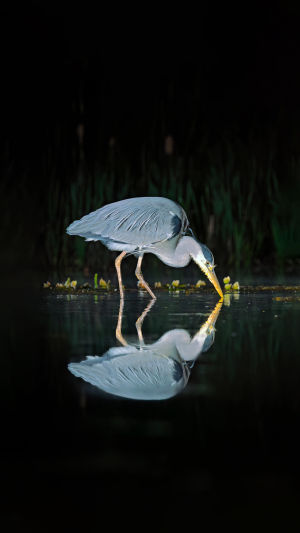
There are moments by rivers and wetlands when everything feels still, almost like the world has paused for a breath. The water moves gently, light shifts across the surface, and a tall bird stands quietly in the shallows, barely disturbing the scene around it.
This is where we often meet the Great Blue Heron, a tall gray-blue bird known for its calm presence and careful movements. It stands like a quiet statue, blending into reeds, rocks, and reflections on the water.
At first glance, it may seem simple, but we soon realize there is much more happening in its world than what meets the eye.
<h3>The Art of Waiting Without Rush</h3>
What makes this bird so fascinating is its way of hunting. Instead of chasing or flying quickly across the water, we see it choose stillness. It steps into shallow areas and holds its position with remarkable patience.
This waiting is not empty time. We can imagine it as a focused moment where the bird studies every ripple and shadow below the surface. Small fish and water creatures move quietly through their environment, and the heron carefully watches for the right signal.
When the moment finally arrives, everything changes in an instant. The neck extends forward in a fast and controlled motion, and the target is captured with surprising precision. This contrast between long stillness and sudden action is what makes its behavior so memorable.
<h3>A Body Designed for Balance and Precision</h3>
When we observe closely, we notice how perfectly the heron’s body supports its way of living. Its long legs help it stand steadily in shallow water without disturbing the surface too much. Its neck stays folded in an “S” shape when resting, storing energy like a flexible spring.
We can also see how its beak plays an important role. It is straight, sharp, and well-suited for quick movement. Even its eyes are highly focused, able to detect subtle motion beneath reflections and light patterns on the water.
Each part of its body works together like a quiet system built for accuracy rather than speed. This balance allows it to survive in changing water environments where patience is often more useful than constant movement.
<h3>Life Around Shared Wetlands</h3>
Beyond hunting, we often find these birds playing an important role in shared natural spaces. During nesting periods, we may see them gathering in groups in tall trees or safe elevated areas near water.
We notice that nest building is a shared effort. One bird collects sticks and small branches, while the other shapes and arranges them into a stable structure. Over time, these nesting sites may grow into large colonies where many birds live side by side.
These shared spaces support more than just one species. They create a small network of life where different birds find shelter, raise their young, and interact with their surroundings in harmony.
<h3>Challenges in Changing Environments</h3>
Even though the heron is skilled and adaptable, it still depends strongly on healthy water environments. Clean shallow areas, quiet nesting zones, and stable feeding grounds are essential for its survival.
We can notice that when these spaces become reduced or disturbed, the bird must adjust its behavior. It may travel farther or search longer for suitable feeding areas. This shows us how closely its life is tied to the balance of its surroundings.
Protecting natural water spaces helps many forms of life, not only this bird. When these environments stay healthy, the entire system becomes more stable and active.
As we walk again near calm waters, Lykkers, we may begin to see things differently. A tall motionless figure standing in the distance is no longer just a bird, but a reminder of patience, focus, and timing. The Great Blue Heron teaches us that action does not always need speed, and silence can hold great awareness. Sometimes, the most powerful moment comes after long observation and calm attention.
Before we leave, we can ask ourselves a simple question: how often do we allow ourselves to pause and truly observe the world around us, instead of rushing past it?


