

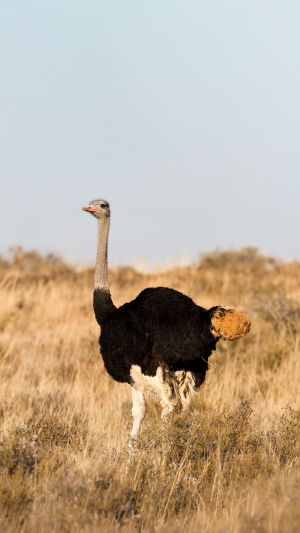
Have you ever stood in front of an ostrich and been amazed by its size? As the tallest bird on Earth, an ostrich can easily stand taller than many people. At first glance, its large wings may make us think it should be able to fly across the sky.
Yet instead of flying, this remarkable bird races across open landscapes at incredible speeds. How did this happen? Let’s explore the fascinating story behind one of nature’s most impressive runners.
<h3>Why Flying Is Not an Option</h3>
Many birds are built for life in the air. They usually have lightweight skeletons, strong chest muscles, and specially designed feathers that help create lift. Ostriches evolved in a very different direction over time.
Their bodies are larger and heavier than those of flying birds. While this structure provides strength and support, it also makes flight impossible. Lifting such a body into the air would require far more power than their muscles can produce.
Another important factor is the chest muscles. Flying birds rely on powerful muscles attached to the breastbone to flap their wings. In ostriches, these muscles are much smaller and not strong enough for flight.
Their feathers are also different. Flying birds have tightly structured feathers that create smooth surfaces for air movement. Ostrich feathers are loose and soft. They help with temperature regulation but are not designed for flying.
<h3>Built Like a High-Speed Runner</h3>
Instead of becoming aerial specialists, ostriches became experts on land. Their bodies are perfectly adapted for speed and efficiency.
The most striking feature is their long, powerful legs. These legs contain strong muscles that allow them to cover huge distances with each stride. A single step can reach several meters.
Their feet are wide and sturdy, with cushioning that absorbs impact while running. This helps them move quickly and safely across uneven ground.
Their leg joints are also highly efficient, allowing smooth and energy-saving movement at high speed.
<h3>Speed as a Survival Advantage</h3>
In open environments, survival often depends on quick reactions and fast movement. Ostriches rely heavily on their ability to run.
A fully grown ostrich can reach speeds of around 70 kilometers per hour, making it one of the fastest two-legged animals on Earth.
When danger appears, speed becomes their most important defense. Instead of hiding, they often escape by outrunning threats across long distances.
This strategy has allowed them to survive and adapt successfully over many generations.
<h3>Excellent Eyesight Helps Them Stay Safe</h3>
Running fast is only part of their survival strategy. Ostriches also have excellent vision.
Their large eyes allow them to detect movement from far away. This early awareness gives them time to react to potential danger.
They usually observe carefully before deciding whether to run. Once they do, they can move quickly to safer areas.
Ostriches also benefit from group living. With many individuals watching the surroundings, threats can be detected earlier.
<h3>Other Birds That Chose a Different Path</h3>
Ostriches are not the only birds that lost the ability to fly.
Some birds adapted to life in water and use their wings for swimming instead of flying. Others adapted to ground living in isolated environments where flight was no longer necessary.
Several large bird species around the world also evolved strong running abilities instead of flight. Each followed a different survival path depending on their environment.
<h3>Interesting Facts About Ostriches</h3>
Ostriches are full of surprises.
A common myth says they bury their heads in the ground. This is not true. The idea likely comes from their habit of lowering their heads while feeding or checking nests.
Baby ostriches are surprisingly large when they hatch and can move almost immediately. This helps them stay with the group and avoid danger early in life.
Their legs are among the strongest in the bird world, used for running, balance, and defense.
<h3>Nature's Trade-Off Created a Champion</h3>
So, Lykkers, now we know why ostriches cannot fly despite having wings. Nature often works through trade-offs. In the case of the ostrich, losing flight opened the door to another extraordinary ability: becoming one of the fastest runners on Earth.
Their strong legs, remarkable eyesight, efficient body design, and smart survival strategies work together perfectly. What may seem like a limitation at first glance is actually a highly successful adaptation.
The next time we visit a zoo or see an ostrich in a documentary, take a closer look at those powerful legs and soft feathers. They tell a fascinating story about adaptation, survival, and the creativity of the natural world.
What surprised you most about ostriches, Lykkers?


