

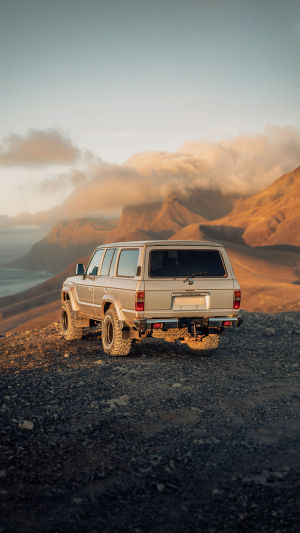
Before spending money on off-road modifications, ask yourself one question: What kind of driving do you actually plan to do?
That answer shapes everything. A vehicle that handles light dirt roads needs different upgrades than one heading deep into rocky backcountry.
Getting the order wrong is one of the most common mistakes people make — and it gets expensive fast.
<h3>Start With Tires, Always</h3>
The single most impactful change you can make is swapping the tires. Ground clearance and suspension mean nothing without grip. Most stock SUVs come with all-terrain tires, which are fine for graded dirt roads but get swallowed quickly in deep mud — the tread fills up and you're essentially running a slick tire.
For more serious conditions, mud-terrain tires have larger tread blocks with reinforced sidewalls that resist punctures from sharp rocks. The trade-off is noise on pavement and reduced grip on dry roads. Rock-terrain tires are similar but optimized for sharp, jagged surfaces.
Snow tires use a different rubber compound that stays flexible in cold temperatures — standard tires essentially go rigid below a certain point, losing grip regardless of tread depth. Always carry a spare that matches your off-road setup, not just the factory spare.
<h3>Suspension and Lift Kits</h3>
A lift kit raises the vehicle's ride height to clear larger obstacles, but it comes with a catch: every inch of additional height shifts the center of gravity upward. That affects how the vehicle handles on pavement and can interfere with factory traction control systems on modern trucks.
A basic 2-inch lift using quality components is a reasonable starting point for most builds. Go beyond 4 to 6 inches and the geometry of the suspension changes enough that you'll need additional work — realigning the differential, extending brake lines, potentially recalibrating the speedometer.
Cheap lift kits that use only spacers and skip drop-down differential brackets are a common trap. They raise the body without properly accounting for drivetrain geometry, which leads to premature wear on CV joints and axles. Buy the right kit for the specific vehicle, not a universal-fit option.
<h3>Installing a Roof Rack</h3>
A roof rack adds serious carrying capacity — recovery boards, extra fuel, camping gear, a rooftop tent — but it needs to be done right. Start by checking the vehicle's manual for the maximum roof load rating. Most passenger vehicles handle between 100 and 200 pounds of cargo up top, and the rack itself typically weighs 20 to 40 pounds, so that payload shrinks fast.
Mounting options depend on the vehicle. Factory mounting points give the most secure attachment. Vehicles with rain gutters can use gutter-mount systems. For vehicles without either, clip-on systems attach to the door frames. Before calling the installation done, re-torque every bolt after the first few miles — components settle and bolts can loosen slightly on initial use.
<h3>The Weight Problem Most Builders Ignore</h3>
Adding a winch, skid plates, rock rails, and a loaded roof rack all at once can push a vehicle past its payload rating. That extra weight affects braking distance, handling, and puts stress on the suspension even if the suspension was upgraded.
Good builds go in stages, and each addition gets evaluated against what the platform can actually handle. Oversized tires without adjusting gear ratios is another classic misstep — it makes the engine work harder, hurts fuel economy, and strains the drivetrain. Modification is rewarding, but the best off-road rigs are the ones built thoughtfully, not all at once.
Start with good tires, add a modest lift if needed, mount your roof rack carefully, and — most importantly — respect your vehicle’s weight limits. Each part works with the others, but only when chosen in the right order. Off-road driving is about freedom, but freedom on the trail starts with discipline in the garage.
Plan your build step by step, test after each addition, and you’ll end up with a rig that’s capable, reliable, and safe — whether you’re crossing a dirt road or climbing a mountain pass.


