

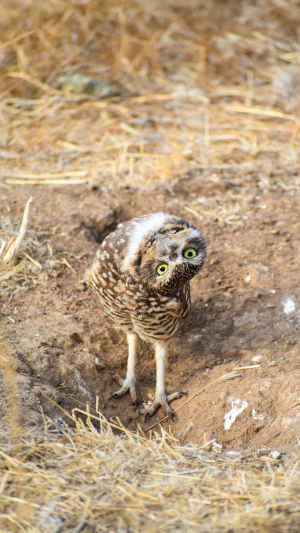
Owls have fascinated people for centuries because of their unusual appearance and remarkable abilities. Their large eyes, silent flight, and mysterious nighttime behavior often make them seem unlike other birds.
Among their most striking features is their dramatic head rotation, which can appear almost unnatural to human observers.
However, this ability is not a strange trick of nature. It is the result of several specialized anatomical adaptations that work together to help owls hunt effectively and survive in their environment.
<h3>Why Owls Cannot Move Their Eyes Like Humans</h3>
Unlike humans, owls cannot move their eyes freely within their skulls. Human eyes sit in rounded sockets and can rotate in different directions, allowing us to quickly shift our focus without turning our heads. This ability lets people observe a wide area with minimal movement.
Owls, however, are built differently. Their eyes remain mostly fixed in position and have very limited movement inside the skull. Because of this restriction, owls cannot simply glance to the side or look behind themselves. To observe their surroundings, they depend heavily on turning their heads.
Although this may initially seem like a disadvantage, evolution provided owls with other physical adaptations that compensate for this limitation.
<h3>Eyes Built for Low-Light Vision</h3>
The structure of an owl's eyes differs significantly from that of humans. Instead of being rounded, owl eyes are elongated and tube-shaped. These eyes are supported by bony structures known as sclerotic rings, which help maintain stability and support.
This eye design offers a major advantage. Larger eyes with a tubular shape can gather greater amounts of light, improving vision in dark conditions. Many owl species hunt during nighttime hours or in low-light environments where visibility is limited.
The ability to collect more light allows owls to detect movement with impressive accuracy. While their fixed eye structure limits movement, the visual benefits help make them highly effective hunters.
<h3>The Neck Designed for Extreme Flexibility</h3>
To compensate for restricted eye movement, owls possess an exceptionally flexible neck structure. Humans have seven cervical vertebrae in their necks, whereas owls generally have fourteen. This increased number provides a much greater range of motion.
Their neck joints and skeletal structure also contribute to flexibility and controlled movement. Instead of turning their entire bodies, owls can rotate their heads rapidly while remaining physically still.
This adaptation plays an important role during hunting. Excessive body movement could reveal a predator's position and alert prey. By minimizing body motion and relying on head movement, owls increase their chances of remaining unnoticed.
<h3>How Far Can an Owl Turn Its Head?</h3>
A common myth suggests that owls can rotate their heads completely around in a full circle. In reality, this is not true.
Most owl species can rotate their heads up to approximately 270 degrees. While this range is remarkable, it still has natural limitations. Compared with human neck movement, however, the difference appears dramatic and often contributes to the eerie impression associated with owls.
Their ability to achieve such a wide range
<h3>The Challenge of Maintaining Blood Flow</h3>
Extreme neck movement creates another important challenge. Rotating the head significantly could potentially compress or damage blood vessels that supply the brain.
In humans, excessive twisting of the neck can place pressure on arteries and affect blood circulation. Scientists therefore questioned how owls repeatedly perform dramatic head movements without causing injury.
Understanding this mechanism became an important focus for researchers studying owl anatomy.
<h3>Special Blood Vessel Adaptations</h3>
Scientific studies revealed that owls possess specialized vascular adaptations that help protect blood circulation during movement.
Owls have enlarged openings within their neck vertebrae that create extra space around important blood vessels. Their arteries also possess flexibility and specialized connections that help maintain continuous circulation.
Instead of behaving like rigid tubes, the blood vessels can adapt more effectively to movement. This system reduces the risk of blocked blood flow and helps ensure that oxygen-rich blood continues reaching the brain during rotation.
<h3>Why These Adaptations Matter During Hunting</h3>
Owls depend heavily on stealth and environmental awareness while hunting. Many species remain motionless for long periods while carefully listening and watching for movement below.
Their specialized eyes help them see under low-light conditions, while their flexible necks allow them to scan broad areas without moving their bodies. This combination helps them remain hidden while observing potential prey.
Even subtle movement beneath leaves or grass can provide valuable information. Detecting these small changes may determine whether a hunt succeeds or fails.
The owl's remarkable head-turning ability is far more than an unusual visual feature. It is the result of a sophisticated combination of fixed eyes, flexible neck structures, and specialized blood vessel adaptations working together as a complete survival system.
What may seem strange from a human perspective is actually an impressive example of evolutionary design. These adaptations allow owls to thrive as efficient predators and continue to make them some of the most fascinating birds in the natural world.


