

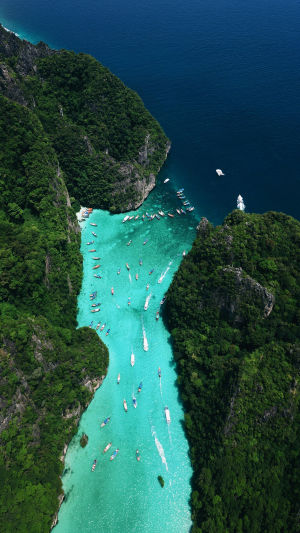
Escape the mechanical grind of the city and recalibrate your senses in the Ko Phi Phi archipelago, a geological masterpiece located in the Andaman Sea.
This isn't just a beach destination; it is a structural marvel of limestone cliffs plunging into crystal-clear basins.
While many islands offer sand and water, Phi Phi provides a high-resolution landscape where the verticality of the rocks meets the transparency of the coral reefs. To truly navigate this district, you must understand the logistical interface between the bustling Tonsai village and the silent, secluded bays that require nautical transport to access. Prepare to audit one of the most vibrant marine ecosystems on the planet.
Phi Phi Islands
<h3>The Nautical Navigation</h3>
Accessing Ko Phi Phi is a purely marine operation. There is no airport on the islands, meaning all arrivals must pass through the Tonsai Pier gateway.
<b>Transport and Logistics Specs</b>
• Ferry Interface: Most travelers arrive via large ferries from Phuket or Krabi. A one-way ticket costs approximately $15–$25, with a transit time of 90 to 120 minutes.
• Speedboat Option: For a faster deployment, speedboats are available for roughly $35, cutting travel time by 50%.
• Local Movement: There are no motorized land vehicles on the main island. Your primary SOP for movement is walking or hiring a long-tail boat for coastal transit.
• Entry Fee: Upon arrival at Tonsai Pier, every visitor must pay a $1 "island maintenance fee" to support local waste management systems.
<h3>The Marine Exploration Zone</h3>
The primary "hardware" of Ko Phi Phi is its surrounding water. The most famous site is Maya Bay, located on the uninhabited Phi Phi Le. This area is a protected natural reserve and operates under a strict environmental maintenance protocol.
The bay is open to visitors from 10:00 AM to 4:00 PM, but note that it often closes for several months annually to allow the coral reefs to regenerate. Entry into the national park area costs approximately $12 for foreign nationals. To avoid the peak thermal load and high visitor density, schedule your nautical departure from Tonsai at 6:30 AM.
Aside from Maya Bay, the "Shark Point" reef offers a chance to observe black-tip reef sharks in their natural habitat—a high-conviction experience for any marine enthusiast.
<h3>Topographical Viewpoint Audit</h3>
To understand the island's dual-bay structure, you must perform a vertical ascent to the Phi Phi Viewpoints. This trek provides a panoramic scan of the narrow isthmus that connects the two main limestone masses.
There are three primary observation levels. Level 1 is a quick 15-minute climb, while Level 3 requires a 30-minute hike through tropical vegetation. The entry fee for the viewpoint path is approximately $1.50. From the summit, you can analyze the symmetrical curvature of Tonsai Bay and Loh Dalum Bay. This is the best location to observe the island's "urban" layout and the density of the surrounding reef systems.
Ensure you carry at least 1 liter of water, as the humidity levels during the ascent can significantly deplete your hydration reserves.
<h3>Accommodation and Sustenance Metrics</h3>
Phi Phi offers a wide range of stay options, from high-spec resorts to basic bamboo bungalows. The pricing is heavily dependent on the proximity to the water and the level of air-conditioning hardware provided.
<b>Practical Stay and Dining Data</b>
1. Lodging Costs: Budget bungalows average $25–$40 per night. Mid-range hotels with pool facilities range from $70–$120, while luxury villas on the northern "Laem Tong" beach can exceed $300 per night.
2. Dining Logistics: A standard meal at a local establishment costs between $5 and $10. Focus on fresh seafood like grilled snapper or the local "Pad Thai" (ordered without restricted proteins).
3. Connectivity: Most hotels provide high-speed Wi-Fi, though the signal strength can fluctuate during heavy tropical rain cycles.
4. Supply Chain: Everything on the island is imported by boat, so prices for consumer goods like sunscreen or snacks are roughly 20% higher than on the mainland.
<h3>The Tropical Operating System</h3>
Ko Phi Phi is a testament to the resilience of natural beauty. It is a district that has undergone massive structural changes, yet its core appeal—the vibrant emerald water and the towering cliffs—remains constant.
Exploring these islands teaches us about the delicate balance between human tourism and environmental preservation. By following the local SOPs, such as using reef-safe sunscreen and respecting the national park boundaries, you contribute to the sustainability of this marine specimen. It is a place where you can disconnect from the digital world and reconnect with the physical mechanics of nature.
Are you ready to board the ferry and witness the limestone giants for yourself, or will you stay grounded in the city? The Andaman is calling, and the water has never been clearer.


