

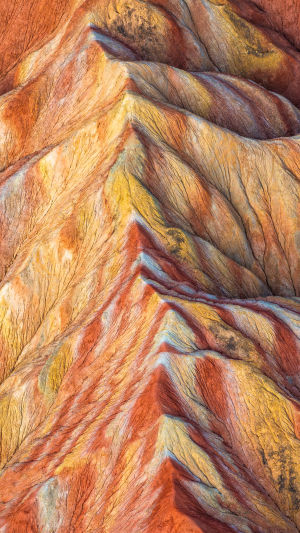
Some landscapes earn their reputation through scale — the overwhelming vastness of a canyon or the unbroken expanse of a desert. The Wave in the Coyote Buttes area of northern Arizona earns its reputation through something entirely different: the precision and complexity of its surface.
Flowing bands of red, orange, gold, and white sandstone curve across the rock in patterns so fluid and so rhythmically consistent that the formation looks less like geology and more like something a sculptor spent years producing by hand.
The colors shift with the light. The lines follow their own internal logic. And the whole composition sits in a remote sandstone wilderness that most visitors to the American Southwest drive past without knowing it exists.
The Wave is located in the Vermilion Cliffs National Monument on the Arizona-Utah border, managed by the Bureau of Land Management. Access is strictly controlled — a maximum of 64 people per day are permitted to enter the area, split between an online lottery and a walk-in lottery at the local BLM office. That restriction is what keeps the formation looking the way it does. Have you heard of The Wave, or has it been sitting at the edges of your American Southwest itinerary? Either way, here is what the site actually involves and how to give yourself the best chance of getting in.
The Wave
<h3>What The Wave Actually Is?</h3>
The Wave is a sandstone rock formation created by wind and water erosion acting on Jurassic-age Navajo Sandstone — rock laid down as ancient desert dunes approximately 190 million years ago. The cross-bedding visible in the formation, where layers deposited at different angles intersect and overlap, creates the flowing, wave-like patterns that give the site its name.
The colors result from varying concentrations of iron oxide and other minerals within the sandstone layers. Red and orange bands contain higher iron concentrations. Pale yellow and white sections reflect lower mineral content and different depositional conditions. The surface erosion that reveals these layers operates at different rates depending on the mineral hardness of each band, creating the textured, striated surface visible up close — thousands of individual erosion channels running parallel down the face of each ridge, giving the rock a fabric-like quality that photographs struggle to fully convey.
The formation sits in a broader landscape of similarly colored sandstone buttes and ridges known as Coyote Buttes North, which surrounds The Wave with comparable geological drama across a trail that takes approximately two to three hours round trip from the trailhead.
<h3>Getting a Permit</h3>
The permit system for The Wave is one of the most competitive in the American public lands system, and understanding how it works is the most important practical step for anyone wanting to visit.
The Bureau of Land Management allocates permits through two separate processes.
1. Online lottery — applications open four months before the desired visit date. Applicants submit their preferred date and are notified approximately one month before the date whether they have been selected. The online lottery costs approximately $9 per application regardless of outcome. Approximately 48 permits per day are allocated through this system.
2. Walk-in lottery — conducted daily at the BLM office in Kanab, Utah at 9 a.m. for the following day's entry. The remaining 16 daily permits are distributed through this process. Applicants must be present in person. Success rates vary significantly by season — winter months see lower competition while peak spring and autumn seasons can see dozens of applicants competing for 16 permits.
Groups of up to six people can apply together on a single application, and if selected, all members of the group receive permits for the same day.
<h3>Getting There</h3>
The Wave trailhead is located near the town of Big Water, Utah, and the Wire Pass trailhead off House Rock Valley Road — an unpaved road that requires a high-clearance vehicle and is impassable when wet. The nearest significant town is Kanab, Utah, approximately 45 kilometers from the trailhead.
Kanab is reachable by car from Las Vegas in approximately two and a half hours via US-89, or from St. George, Utah in approximately one hour. There is no public transportation serving the area. Car rental from Las Vegas McCarran Airport starts from approximately $45 to $70 per day for a standard vehicle, though a high-clearance four-wheel drive vehicle — available from approximately $80 to $120 per day — is strongly recommended for the final unpaved road section to the trailhead.
From Kanab, the drive to the Wire Pass trailhead takes approximately 45 minutes on paved road followed by 14 kilometers of unpaved road. The trailhead has no facilities beyond a basic information board.
<h3>The Hike and What to Bring</h3>
The trail from Wire Pass trailhead to The Wave covers approximately 9.5 kilometers round trip with minimal elevation change — the difficulty comes from route-finding across unmarked terrain rather than gradient. Permit holders receive a map and a set of photographs identifying navigation landmarks, which is the only guidance provided. There are no trail markers, signs, or established path across the slickrock and sandy sections.
The hike takes most visitors between three and five hours depending on pace and time spent at the formation. Several practical considerations apply specifically to this route.
1. Water — a minimum of four liters per person is recommended. There is no water source along the route and the desert environment creates dehydration risk even in cooler conditions.
2. Sun protection — the slickrock terrain provides no shade at any point along the route. A wide-brimmed hat, sunscreen, and sun-protective clothing are essential regardless of season.
3. Footwear — closed-toe shoes with good grip are required for the slickrock sections. Sandals are genuinely dangerous on the steeper rock surfaces.
4. Timing — starting before 8 a.m. allows arrival at The Wave before the midday heat and midday light, which flattens the color contrast that makes the formation most visually dramatic.
<h3>Where to Stay</h3>
Kanab serves as the primary accommodation base for Wave permit holders, offering a range of options from budget motels to boutique properties.
Canyons Boutique Hotel is the most design-forward property in Kanab, with rooms from approximately $150 to $220 per night. Canyons Lodge offers comfortable mid-range accommodation from approximately $100 to $150 per night with convenient location near the BLM office for walk-in lottery participants needing an early morning arrival.
For budget travelers, several well-reviewed motels in Kanab offer clean rooms from approximately $60 to $90 per night. Camping is available at the nearby Coral Pink Sand Dunes State Park from approximately $20 to $30 per night for those preferring to stay closer to the natural environment.
The Wave is one of those places where the restriction on access is part of what makes the visit meaningful. Standing in a landscape that only 64 people reached that day — and that only those 64 people will see in exactly that light, at exactly that angle, on exactly that morning — produces a quality of experience that unlimited access would immediately destroy. Have you entered the lottery for The Wave, or is this the moment it moves from something you have seen in photographs to something you are actively planning to stand inside? Either way, the sandstone will be that color, the lines will be exactly that precise, and the formation will be worth every application it takes to finally get there.


