

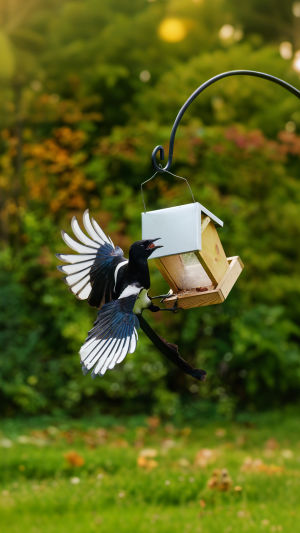
The Eurasian Magpie (Pica pica) is one of the most distinctive and intriguing birds in the avian world.
With its bold black-and-white feathers, sharp beak, and inquisitive nature, this bird has a reputation for intelligence and resourcefulness. Often seen hopping around in open fields, near roads, or perched on rooftops, the Eurasian magpie is more than just a striking bird—it has a fascinating range of behaviors and skills that make it truly stand out.
In this article, we will uncover some of the most captivating facts about the Eurasian magpie. From its impressive intelligence to its symbolic significance, this bird has much more to offer than meets the eye.
<h3>A Remarkable Memory</h3>
<b>Problem-Solving and Memory:</b>
The Eurasian Magpie is often celebrated for its remarkable memory. Studies have shown that magpies can recognize and remember faces, an ability that is usually associated with humans and some primates. This means that magpies can identify individuals who have interacted with them, whether in a positive or negative way.
In addition, they are known to store food in multiple locations, a behavior that highlights their strong spatial memory. By caching food in various spots, the magpie ensures that it has enough to eat during lean times. This impressive memory is a testament to the bird's survival instincts and cognitive abilities.
<h3>Tool Use and Innovation</h3>
<b>Magpies Are Tool Users:</b>
Not only do magpies have excellent memory, but they also exhibit the ability to use tools. In the wild, they have been observed using twigs, leaves, and even discarded human objects to extract food from hard-to-reach places. This behavior is rare among birds and demonstrates problem-solving ability.
For example, magpies have been seen using long, slender sticks to reach insects or small animals hiding in tree bark. They are true survivors, using whatever resources they can find to meet their needs.
<h3>Highly Social Creatures</h3>
<b>Magpies Form Strong Bonds:</b>
The Eurasian Magpie is a highly social bird, often found in groups, especially outside the breeding season. These groups can range from a few individuals to large flocks, depending on the availability of food and the time of year. The birds communicate with each other through a variety of calls and displays, which helps maintain cohesion within the group.
They are known for their cooperative behavior, such as mobbing predators to protect themselves and their nests. This teamwork-oriented approach makes them one of the most socially dynamic bird species.
<h3>Symbolic Significance</h3>
<b>Magpies in Culture:</b>
The Eurasian Magpie has a long history of symbolic significance across various cultures. In many regions, it is associated with both good and bad luck. For example, in Western European folklore, magpies are often considered omens of fortune—either bringing good luck or misfortune, depending on the number of birds seen together. One of the most well-known superstitions is the rhyme “One for sorrow, two for joy,” which suggests that spotting a solitary magpie brings sorrow, while seeing two brings joy.
In some Asian cultures, magpies are considered symbols of happiness and prosperity. The bird's black-and-white plumage is also seen as a representation of balance and harmony.
<h3>Magpies Are Smart Learners</h3>
<b>Learning Through Observation:</b>
The Eurasian Magpie's intelligence is not limited to memory and tool use; it also extends to learning from others. This bird is an adept observer and can learn new behaviors by watching other magpies or even humans. Whether it's discovering new feeding techniques or understanding how to manipulate certain objects, magpies are quick learners who adapt well to their surroundings.
In fact, researchers have shown that magpies can pass on learned behaviors to other magpies, further emphasizing their social learning abilities. This trait is one of the reasons why magpies are able to thrive in a variety of environments, from rural farmlands to urban cities.
<h3>Magpies Have a Complex Vocal Range</h3>
<b>Communication Skills:</b>
The Eurasian Magpie is known for its complex vocalizations, which it uses for a variety of purposes. These include establishing territory, communicating with other members of its flock, and signaling danger. They have a range of sounds, from whistles and chattering calls to harsh warning noises.
One interesting aspect of their vocal behavior is their ability to mimic sounds. In urban environments, magpies have been observed imitating the sounds of car alarms, sirens, and even human-like sounds. This ability to mimic demonstrates their adaptability and intelligence in a changing environment.
<h3>Magpies Are Protective Parents</h3>
<b>Parenting and Nesting:</b>
Eurasian Magpies are fiercely protective of their nests and young. They build large, dome-shaped nests in tall trees, where they lay several eggs. Both the male and female share the responsibility of incubating the eggs and protecting them from predators.
Once the eggs hatch, the parents continue to care for the chicks, feeding them and keeping them safe from potential threats. The magpies' protective nature ensures the survival of their offspring, which is vital for maintaining the population.
<h3>The Clever and Captivating Magpie</h3>
The Eurasian Magpie is a bird that never fails to impress with its intelligence, adaptability, and social nature. Whether it's using tools, solving problems, or communicating with its flock, the magpie proves time and time again that it is one of the most fascinating birds in the world.
Despite its sometimes mischievous reputation, the Eurasian Magpie is a symbol of resilience and adaptability. Its ability to thrive in a variety of environments, its impressive cognitive skills, and its complex social behaviors make it a bird worth admiring. So, next time you spot a magpie, take a moment to appreciate the intelligence and resourcefulness that lie behind its striking appearance.


