

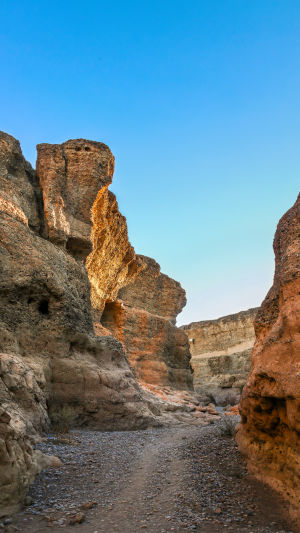
Imagine standing at the bottom of a gorge so narrow you can touch both walls with outstretched arms, while ancient sedimentary rock towers 30 meters above your head on either side.
This is Sesriem Canyon — one of Namibia's most extraordinary natural features, carved by the Tsauchab River over two million years of patient, relentless erosion.
Most visitors to the Sossusvlei region rush past it on the way to the famous red dunes. That's a mistake you don't want to make.
Sesriem
<h3>What Makes Sesriem Canyon So Remarkable</h3>
Sesriem Canyon stretches approximately one kilometer in length and reaches up to 30 meters deep, with some sections narrowing to just two meters wide. Walking its length feels like moving through the earth itself — the layered rock walls reveal millions of years of geological history in visible cross-section.
Around 15 to 18 million years ago, layers of sand and gravel were deposited when the Namib was a wetter environment, and the canyon's sedimentary walls tell that story clearly to anyone who looks closely.
The name itself carries history. "Sesriem" is an Afrikaans word meaning "six rawhide thongs" — named by early settlers on the Dorsland Trek who had to tie six such straps together simply to lower a bucket far enough to reach the water at the canyon floor. That water is still there.
The pools at the bottom are replenished by seasonal rains and hold water for much of the year, attracting desert wildlife and offering visitors the rare sight of a permanent water source in one of Earth's oldest deserts.
<h3>Getting There</h3>
Sesriem Canyon sits just 4.5 kilometers from the entrance to the Namib-Naukluft National Park, approximately 400 kilometers from Swakopmund, and about a five-hour drive from Windhoek.
Transportation options include:
1. Self-drive — the most popular approach; a standard 2WD vehicle handles the paved road to Sesriem; a 4WD is recommended for deeper exploration toward Deadvlei.
2. Charter flights — charter flights are available from Eros Airport in Namibia to surrounding airstrips near Sossusvlei Lodge, Sesriem, and Geluk Kuala Lodge; transfers can then be arranged through private operators.
3. Guided tours — safari operators run multi-day packages from Windhoek that include Sesriem Canyon and Sossusvlei, with budget options starting around $150 per person per day.
<h3>Opening Hours and Entrance Fees</h3>
The Sesriem gate — the main access point to the Namib-Naukluft National Park — operates two gates with different hours. The outer gate is open from dawn to dusk. The inner desert gate opens one hour before sunrise and closes one hour after sunset, giving early risers privileged access to the dunes and canyon at golden hour.
Park entrance fees are paid at the Sesriem gate and are valid for 24 hours. The fee structure is approximately 8 USD per person plus 2.7 USD per vehicle, with children under eight years entering free — roughly $8 per person and $3 per vehicle at current exchange rates. Cash and major credit cards are accepted at the gate.
<h3>Where to Stay</h3>
Staying inside or immediately at the park gates gives you a critical advantage: access to the canyon and dunes at sunrise before day visitors arrive.
1. Budget — Sesriem Campsite (NWR Government Camp): The Sesriem Campsite offers a bar, restaurant, shop, pool, and gas station. Camping costs approximately $37 per person per night at current rates. Basic but well-located.
2. Mid-Range — Sesriem Oshana Campsite: Each private campsite includes its own toilet, shower, kitchenette, hot and cold water, and electricity, with access to the NWR facilities next door. Rates start around $60 to $80 per person per night.
3. Luxury — Dead Valley Lodge: A stylish property offering private tented chalets with panoramic desert views, air conditioning, electricity, a private patio, kitchenette, and en-suite bathroom — prices start around $250 to $350 per person per night including breakfast.
4. Luxury — Le Mirage Resort & Spa: Designed to resemble a turreted castle in the desert landscape, Le Mirage offers luxurious rooms with walk-in showers, air conditioning, and an excellent onsite restaurant. Rates range from $300 to $500 per person per night.
<h3>Best Time to Visit and Practical Tips</h3>
The best time to visit is during the cooler months of April through October, when daytime temperatures are manageable and walking the canyon floor is comfortable. In summer months, canyon temperatures can be extreme. Early morning visits offer the best light for photography and the coolest walking conditions.
1. Wear sturdy, closed-toe shoes — the canyon floor involves uneven rock surfaces and occasional scrambling.
2. Carry at least two liters of water per person regardless of season.
3. Bring a hat, sunscreen, and sunglasses — shade is limited outside the canyon itself.
4. Stock up on supplies in Windhoek — the Sesriem settlement offers only basic provisions.
5. Fill your fuel tank whenever you have the opportunity; fuel distribution in this region can be unpredictable.
Sesriem Canyon won't dominate your photos the way the towering red dunes of Sossusvlei will. But stand quietly at the bottom of that narrow gorge, with two million years of geological time pressing in from both sides, and you'll understand why travelers who take the time to explore it remember it long after the dune photographs have faded from memory. Some of the best experiences in travel are the ones that don't announce themselves loudly. This is one of them.


