

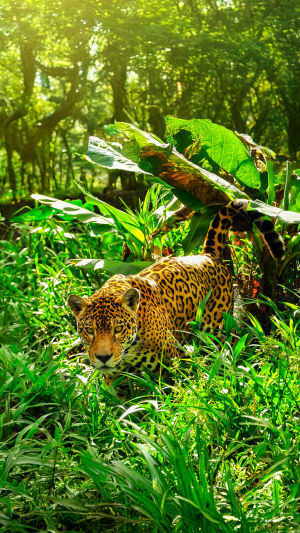
Deep in the heart of the rainforest, a powerful shadow moves silently through trees and rivers. Jaguars, the strongest cats, command forests, wetlands, and rivers with unmatched strength and stealth.
Famous for their incredible bite and a rare hunting technique that strikes directly at the skull, these big cats are true masters of surprise.
Today, with shrinking habitats and increasing encounters with humans, life is getting harder for them. Learning about their world is the first step we can take to help protect these jungle kings.
<h3>Diverse Homes Across the Continent</h3>
Jaguars can live in a wide range of environments, but they thrive where water is plentiful and vegetation is dense. Lowland forests in the Amazon Basin and Central America provide abundant prey and excellent hiding spots.
The Pantanal, the largest tropical wetland on Earth, is another key home. Its open waters and island-like terrain make hunting easier for jaguars. But they aren’t limited to untouched forests.
Jaguars can adapt to areas near human activity if there’s enough food and cover. They may live in secondary forests, the edges of farmland, and even shrubby areas near villages. Yet as forests are cut down, roads built, and cities expanded, jaguars’ spaces shrink, and encounters with humans rise. Protecting their habitats is now more important than ever.
<h3>Solitary Night Wanderers</h3>
Jaguars are true loners. Once grown, they mostly stay alone except during mating. Each jaguar claims its own territory—males often cover 50–100 square kilometers, sometimes more, while females take smaller areas of 20–50 square kilometers. Male territories may overlap several females’ ranges, but jaguars avoid fighting other males when possible.
They’re mostly active at night and during dawn or dusk, resting during the day in tree hollows, rock crevices, or thick foliage. This schedule helps them avoid heat and catch prey off guard. Although jaguars can climb and swim, most hunting happens on the ground. They are one of the few cats that truly enjoy water, often catching fish or even chasing semi-aquatic animals like capybaras underwater.
<h3>Master Hunters with Unique Tactics</h3>
Jaguars eat a wide variety of prey—over 80 species have been recorded. They hunt deer, peccaries, capybaras, tapirs, monkeys, birds, and even caimans and fish. In the Pantanal, capybaras and caimans are staple meals, while Amazon jaguars often focus on tree-dwelling mammals and large rodents.
They hunt mainly by ambush. Their golden coat with black rosettes blends perfectly into the forest, letting them silently approach prey. Unlike other big cats, jaguars often use a “skull-piercing” technique: they bite straight through the skull to strike the brainstem, killing prey instantly. This method is especially effective for hard-shelled animals like turtles or caimans.
<h3>Territory Signs and Communication</h3>
Even as solitary hunters, jaguars communicate in clever ways. They mark territory with scent, scat, and claw marks, and they can roar or make a low “sawing” call that carries for miles. This sound is rough and unique, unlike lions’ deep roars or tigers’ long calls.
Jaguars also leave visual signals. They might leave prey in a visible spot or drag it into a tree for storage. While they don’t hide food in branches as often as leopards, in areas with high competition, they still use trees to protect meals from other predators like cougars or vultures.
<h3>Raising the Next Generation</h3>
Jaguars don’t have a fixed breeding season, though mating is more common just before or after the rainy season. Females signal readiness through scent and calls, and the mating period lasts a few days. Gestation lasts about 93–105 days, producing 1–4 cubs, with an average of 2.
Cubs are blind at birth, fully spotted, and entirely dependent on their mother. They open their eyes around two weeks, start eating meat by two months, and follow their mother to learn hunting skills around six months. Cubs stay with their mother for 1.5–2 years before leaving to establish their own territories. Females mature around 2.5 years, and males a bit later, at 3–4 years.
Young jaguars face many dangers, from other jaguars to large birds and snakes, making the first year critical. Mothers are extremely vigilant, moving dens frequently to avoid threats.
<h3>Threats and Conservation Efforts</h3>
Jaguars are essential to keeping ecosystems balanced, but their numbers are declining. The IUCN lists them as Near Threatened. Habitat loss, fewer prey, illegal hunting for skin or body parts, and retaliatory killings due to livestock attacks are major threats.
Conservation efforts are growing. Protected areas, wildlife corridors, and community-managed programs help jaguars survive. In Brazil’s Pantanal, eco-tourism encourages locals to tolerate jaguars. In Costa Rica, jaguars are celebrated as a national symbol, highlighting their ecological importance.
<h3>Why We Should Care</h3>
Jaguars are more than iconic animals—they keep forests and wetlands healthy. Strong, mysterious, and elegant, they silently maintain the rainforest’s balance. Protecting them is not just about saving one species; it’s about safeguarding biodiversity across the Americas. By respecting nature and reducing human impact, we can help these jungle kings continue roaming freely under the moonlight.
Hey Lykkers, next time you think of a rainforest, remember the jaguar lurking quietly—always powerful, always mysterious, and always deserving our care.


