

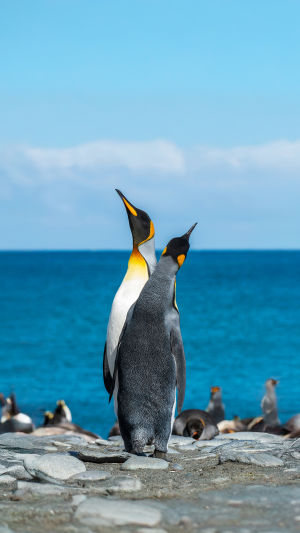
A penguin standing upright on ice looks almost comical—short legs, stiff posture, wings that seem too small for flight.
Yet the moment it dives, the transformation is dramatic. What appeared awkward on land becomes streamlined and precise underwater. Why would a bird give up the sky, only to master the sea?
The answer lies in evolution. Penguins did not fail at flying; they specialized. Over millions of years, natural selection reshaped their bodies for aquatic efficiency. Their wings did not weaken—they transformed into some of the most effective propulsion tools in the avian world.
<h3>From Air to Water: An Evolutionary Trade-Off</h3>
<b>1. Fossil Evidence of Flying Ancestors</b>
Fossil records show that early penguin ancestors lived more than 60 million years ago, shortly after the extinction of the dinosaurs. These early forms already exhibited reduced flight capability but increasingly adapted features for swimming. Unlike seabirds such as albatrosses, which retained lightweight bones for flight, penguins evolved denser bones. This reduced buoyancy and made diving easier.
<b>2. Wings Reshaped into Flippers</b>
In flying birds, wings generate lift by moving air over flexible feathers. In penguins, wings became stiff, flat, and paddle-like. The joints are less flexible, forming a rigid structure ideal for pushing against water. Water is nearly 800 times denser than air, requiring more forceful propulsion. A flexible wing would waste energy; a solid flipper maximizes propulsive force.
<b>3. Muscle Redistribution for Power</b>
Penguins possess large pectoral muscles relative to body size—similar in proportion to strong flying birds, but optimized differently. Instead of producing lift, these muscles generate underwater propulsion. Each powerful flipper beat functions like a swimmer's butterfly motion, driving the body forward with force.
<h3>Engineering for Speed and Efficiency</h3>
<b>1. Streamlined Body Shape</b>
Penguins have torpedo-shaped bodies that reduce drag. Their short necks, tapered heads, and tightly packed feathers minimize turbulence. This hydrodynamic design allows certain species, such as the gentoo penguin, to reach speeds up to 36 kilometers per hour underwater.
<b>2. Countershading Camouflage</b>
The classic black-and-white coloration serves a strategic purpose. From above, the dark back blends with deep ocean water; from below, the white belly merges with sunlight filtering through the surface. This camouflage increases hunting success while reducing detection by predators.
<b>3. Controlled Buoyancy and Feather Structure</b>
Penguin feathers are densely packed—up to 100 feathers per square inch in some species. Beneath the outer waterproof layer lies insulating down. By adjusting air trapped within their feathers, penguins can regulate buoyancy during dives, allowing precise depth control.
<h3>Master Hunters Beneath the Surface</h3>
<b>1. Diving Capacity</b>
The emperor penguin holds the diving record among birds. It can reach depths exceeding 500 meters and remain submerged for over 20 minutes. This capability is supported by physiological adaptations such as efficient oxygen storage in muscles and the ability to slow heart rate during deep dives.
<b>2. Visual Adaptation Underwater</b>
Penguin eyes function effectively both above and below water. Their flattened corneas compensate for the refractive difference between air and water, allowing clear underwater vision. Accurate depth perception supports rapid pursuit of fish, squid, and krill.
<b>3. Coordinated Hunting Techniques</b>
Some species hunt cooperatively, herding schools of fish into tighter clusters before striking. Quick directional changes are made possible by flipper control and webbed feet that act as rudders. This agility turns apparent clumsiness on land into underwater precision.
What appears to be a limitation—loss of flight—is in fact a specialization. Evolution does not reward versatility alone; it favors efficiency within an ecological niche. Penguins inhabit environments where food lies beneath the surface, not in the sky. Natural selection shaped their bodies accordingly.
Watching a penguin leap from the water onto ice, droplets scattering in the air, it becomes clear: this is not a bird grounded by failure. It is a bird refined by purpose. The sky may have been surrendered, but in exchange, the ocean became theirs.


