

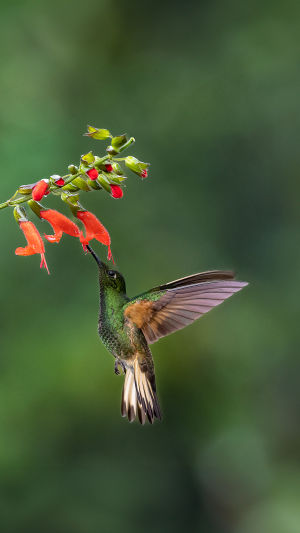
Hello Lykkers! Today, we are going to explore a very small but incredibly charming bird — the White-tailed Emerald.
When we think about hummingbirds, we often imagine bright colors and fast wings, but the White-tailed Emerald feels even more special. It looks like a tiny piece of green light flying through the forest. Once we notice it, it becomes hard to forget.
<h3>Where We Can Find the White-tailed Emerald</h3>
The White-tailed Emerald lives mainly in the mountain forests of Central America. We can usually find it in places like Costa Rica and western Panama, especially in the Talamanca mountain range. These areas are cool, misty, and full of tall trees and flowering plants.
We often see this bird at middle or higher elevations, where the air feels fresh and the forest is thick. It likes forest edges, clearings, and sometimes gardens near natural areas. These places provide plenty of flowers, which means a steady supply of nectar. For the White-tailed Emerald, flowers are not just beautiful — they are daily energy.
<h3>Its Size: Small but Powerful</h3>
The White-tailed Emerald is extremely small. Its body length is only about 7.5 to 8 centimeters, which is shorter than most people’s fingers. Its weight is around 3 grams, so light that even a strong breeze could move it.
Even though it is tiny, it is full of energy. We can see it flying almost nonstop during the day, moving quickly from flower to flower. Its wings beat so fast that they often look like a blur, and the soft humming sound gives hummingbirds their name.
<h3>Beautiful Colors and Unique Tail</h3>
One of the most striking features of the White-tailed Emerald is its color. The back shines in bronze-green, especially under sunlight. When we look closely, we may notice that the upper tail area looks darker and more copper-like.
The tail is what truly makes this bird special. The central tail feathers are bronze, while the outer ones are bright white with dark tips. This white tail creates a strong contrast when the bird is flying, making it easy to recognize.
The throat and chest glow in bright green, while the belly is mostly white. Females look similar but slightly softer in color. Young birds usually appear less shiny, and their feathers become brighter as they grow.
<h3>Daily Habits and Feeding Style</h3>
The White-tailed Emerald spends most of its time searching for nectar. We often see it hovering in front of flowers, using its long, straight bill to reach deep inside. Nectar gives it quick energy, which is necessary because flying costs a lot of power.
Besides nectar, it also eats small insects. These provide important nutrients and help keep its body strong. The bird usually feeds alone and may protect its favorite flowers from other birds by chasing them away.
<h3>Behavior and Personality</h3>
Even though it looks gentle, the White-tailed Emerald can be quite bold. It does not like to share food and often shows strong territorial behavior. When another bird comes too close, it may suddenly rush forward to scare it away.
At the same time, it is very curious. We may see it exploring new flowers or flying around unfamiliar objects in its environment. This mix of courage and curiosity makes it fun to watch.
<h3>Conservation and Why It Matters</h3>
The White-tailed Emerald is currently listed as “Least Concern,” which means its population is stable. This is good news for both bird lovers and nature lovers. However, we should remember that mountain forests are sensitive environments.
Deforestation and climate changes can slowly reduce suitable habitats. If forests disappear, the flowers disappear too, and without flowers, hummingbirds cannot survive. Protecting forests helps ensure that this tiny green jewel can continue to shine in the future.
<h3>Final Thoughts for Lykkers</h3>
Lykkers, the White-tailed Emerald teaches us an important lesson: beauty does not need to be big to be meaningful. Sometimes, the smallest creatures carry the strongest sense of wonder.
Next time we walk through a forest or garden, let’s slow down and look around carefully. If we see a flash of green and white flying past, we may just be lucky enough to meet the White-tailed Emerald — a tiny reminder that nature is full of quiet miracles.
The White-tailed Emerald
Video by James Wolfe


